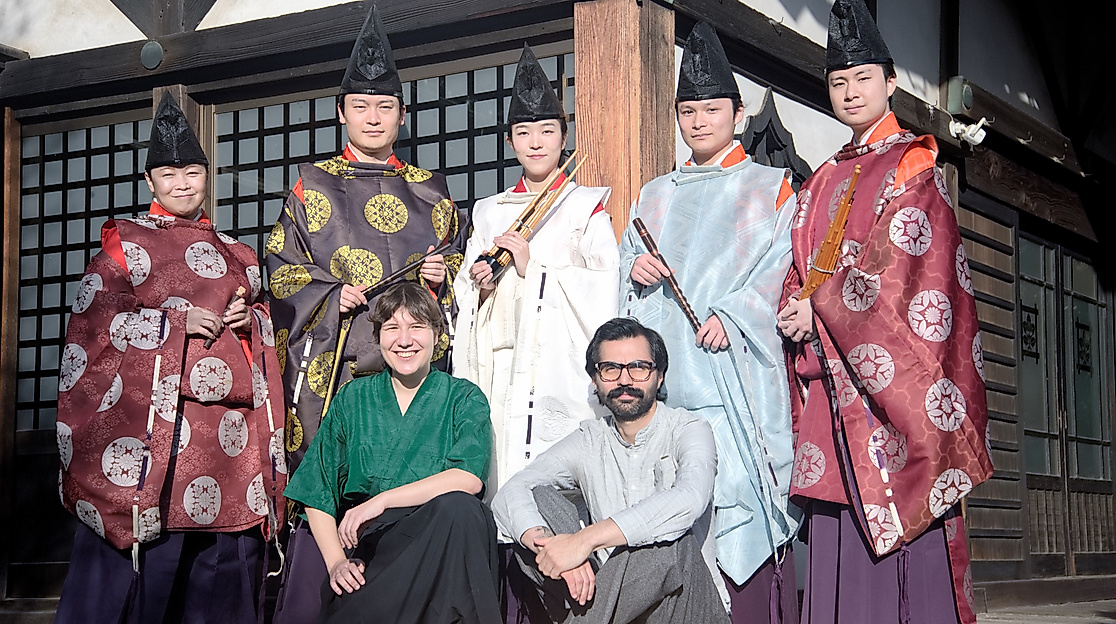
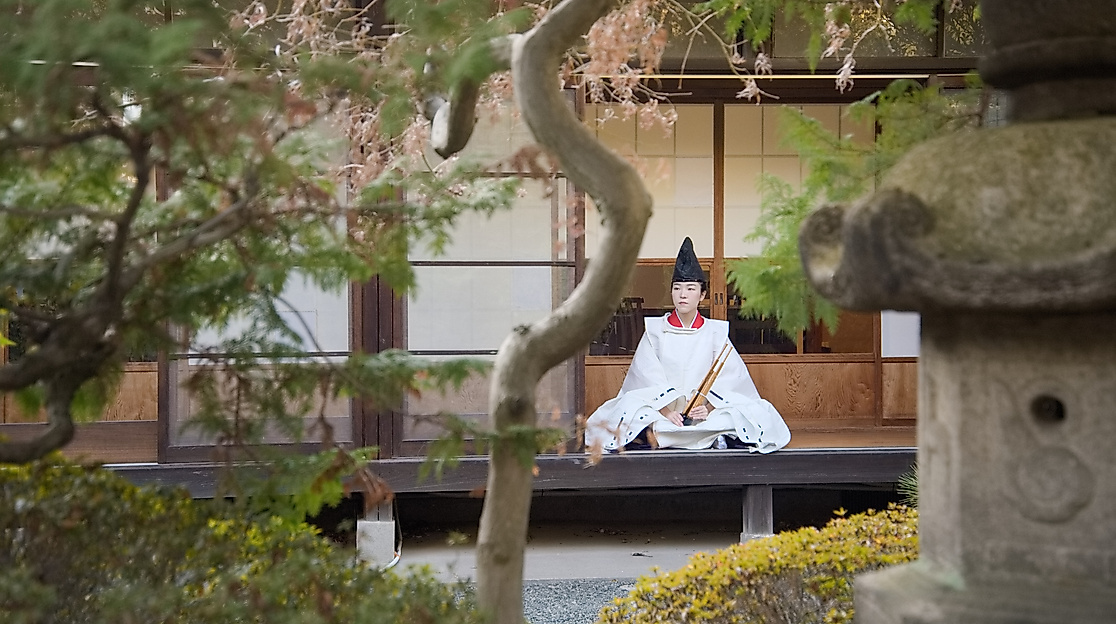
As a special highlight of the evening, Tee& is delighted to present the Tokyo International Gagaku Orchestra.
Students and faculty from Tokyo University of the Arts will bring the ancient Japanese court music of Gagaku to Planten un Blomen — and you can experience it live with us!
Following the ikebana lecture by artist Yusui Uchiyama at 6 p.m., the concert will begin at 7 p.m. with a short introduction by Sophie Steiner, award-winning harpist and Artistic Director of the Shirabe Festival. You will then have the rare opportunity to listen to the ancient sounds of ritual music once performed at the Japanese imperial court.
Gagaku, literally “elegant music,” is Japan’s ancient court music and one of the world’s oldest orchestral traditions still performed today. Its roots go back more than a thousand years: influences from China, Korea, and other parts of Asia were absorbed at the Japanese imperial court and developed into a unique art form combining ceremony, ritual, dance, and instrumental music.
For listeners accustomed to Western music, Gagaku may at first defy expectations. Its sound can seem unfamiliar, raw, or even cacophonous before its inner calm and order begin to emerge. Yet that is precisely what makes it so fascinating: the floating chords of the shō mouth organ, the piercing tone of the hichiriki, the bright sound of the ryūteki transverse flute, and the accents of drums and gong create music of stillness, breath, and deep concentration. It invites listeners to set aside familiar ways of hearing and allow each individual sound to unfold.
This concert is made possible by our arts sponsor, Will IT GmbH.
Will IT GmbH specializes in cloud solutions, Microsoft cloud services, and IT transformation. The company helps businesses make their infrastructure, licensing, and digital processes more efficient, offering tailored consulting, migration, and ongoing support.
Our heartfelt thanks go to William Marberry, Vanessa Wischmann, and the entire team for their support.
More information:
https://willitcloud.de
Our sincere thanks also extend to the German-Japanese Youth Society and the Hamburg University of Music and Theatre, especially Prof. Frank Böhme, for his tireless commitment to preserving traditional arts.

