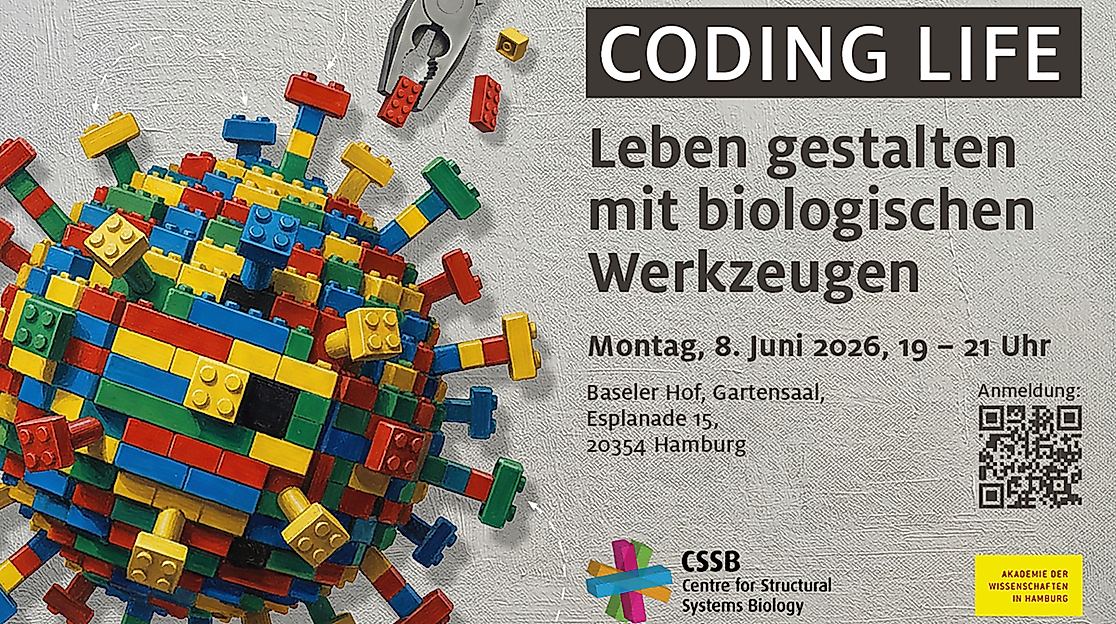
What if we could not only understand life, but also actively program it? The event “Coding Life – Shaping Life with Biological Tools” delves deeply into synthetic biology with renowned experts. The panelists will discuss the topic at the invitation of the Centre for Structural Systems Biology (CSSB) and the Academy of Sciences and Humanities in Hamburg on June 8, 2026, at 7:00 p.m. in the Gartensaal of the Baseler Hof in Hamburg.
“Coding Life” refers to the principle that cells function like tiny high-tech computers. They read the genetic code, which researchers rewrite, supplement, or completely reinvent. Advances in the field of synthetic biology are rapid—driven largely by artificial intelligence (AI). Modern AI models can now calculate complex protein structures within seconds and even design new, tailor-made proteins. In the near future, so-called AI agents could enable the next major leap in efficiency: They are increasingly planning experiments independently, analyzing data, and optimizing biological designs—making human intervention less and less necessary.
The impending automation raises questions that the panel discussion will explore. These include:
• What are we allowed to change?
• How much control should we cede to autonomous AI systems in the future?
• Who owns the knowledge generated by machines?
• Do we still think for ourselves, or do we merely prompt the machines?


