Marco Polo Tower

  • hafencity_unilever-haus_c-felix-neumann
    © Felix Neumann
  • marco-polo-tower_hafencity_c-2018-timo-sommer-lee-maas
    © Timo Sommer, Lee Maas
  • hafencity_c-2018-timo-sommer-lee-maas-4
    © Timo Sommer, Lee Maas

With interlocking storeys and a glass front, the Marco Polo Tower is a real eye-catcher!

The impressive Marco Polo Tower is located directly on Strandkai. The 55 metre high building was completed on 03 April 2009 and fascinates with its special architecture. Already in 2009 it was awarded the European Property Award in the category building construction project.
Compared to the surrounding floors, each floor is turned a few degrees around the axis of the building. The higher the floor, the more expansive the floors become. In this way, the smallest floor is the ground floor and the largest the twelfth floor.
The Marco Polo Tower serves as a residential building from the second floor onwards. Apartments had already been sold before completion.
From here, residents have a perfect panoramic view over the harbour and Hamburg's numerous landmarks and are directly involved in city life. This is also reflected in the price: Those who want to live in the luxury building pay up to 3.7 million euros for individual apartments. This makes the Marco Polo Tower one of the most expensive living spaces in Hamburg.

More on this subject

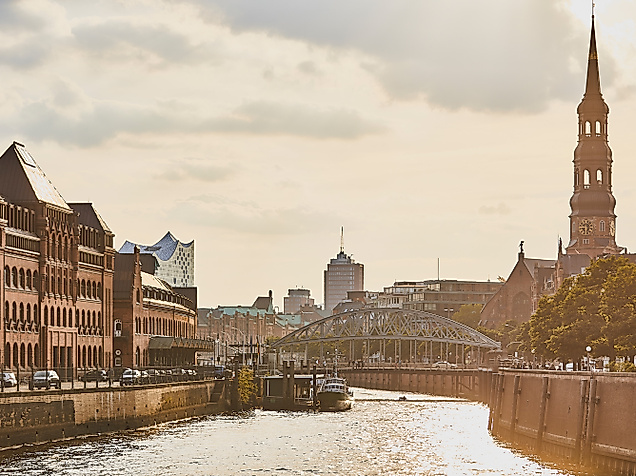
Abendstimmung in der Hamburger Speicherstadt mit Blick auf Kanal, historische Gebäude und Kirchturm
© ThisIsJulia Photography

CITY AREA PORTRAIT HafenCity & Speicherstadt

The world’s largest warehouse complex and UNSESCO World Heritage. On the other side, towards the banks of the Elbe, the modern, ever-growing architecture of the new harbour district HafenCity. Also, you can enjoy the view of the harbour from nearly everywhere.

HafenCity & Speicherstadt

THIS MIGHT INTEREST YOU AS WELL Further recommendations

st-nikolai_c-2018-thisisjulia-photography-2
© ThisIsJulia Photography

The main church at Klosterstern. Hauptkirche St. Nikolai am Klosterstern

The new building was erected from 1846 to 1874 in the neo-Gothic style to designs by the English architect Gilbert Scott and was destroyed by the bombings during the Second World War in 1943; the ruins were demolished in 1951.

Unlike the other principal churches, after the war the parish of St. Nikolai decided in 1956 against rebuilding the church on the Hopfenmarkt and instead dared a new beginning at the Klosterstern in Harvestehude, a densely populated district of the city. The new church on Klosterstern (Harvestehuder Weg 118) was built according to designs by Gerhard Langmaak and was dedicated in 1962.
Considered as both a special feature and attraction is the altar mosaic based on a design by Oskar Kokoschka, as well as the Coester window from 1939.
The former location of the main church of St. Nikolai with the 147-metre church tower – the third highest in Germany – is a ruin worth seeing on Hopfenmarkt and is considered a memorial and as a place for exhibitions and events.


Hauptkirche St. Nikolai am Klosterstern
Inner Alster
© Lars Meinel – stock.adobe.com

Binnenalster

In addition to the harbour, the Alster forms the maritime face of the city of Hamburg. The Alster, divided in to Binnenalster and Außenalster by the Lombardsbrücke, is a meeting point and attraction for tourists and Hamburgers alike.

Binnenalster

Top customer reviews

No reviews available.

Write new rating

This is your text

Your rating *

Languages

Google translator for other languages

Please note that this is an automatic translation.
For better information, you can always switch to the German or English version