Meßberghof

This house was built at the same time as the Chilehaus and was thus one of the first Kontor-houses in Hamburg.

 It obtained the name Ballinhaus from the famous ship owner Albert Ballin. In 1938, the Nazi regime renamed it “Meßberghof”. The Meßberghof has ten floors and a direct line of sight to the Speicherstadt on the inner side of the customs channel. In contrast to the Chilehaus, the Meßberghof captivates with its peaceful, deliberately constructed two-dimensional façade. However, the entrance hall impresses viewers with the staircase with round staircase eye, the floor with bright polished sandstone clad plates and the travertine or coloured tiles. Today the Hachez Chocoversum can be found in the rooms of the Meßberghof.
More on this subject

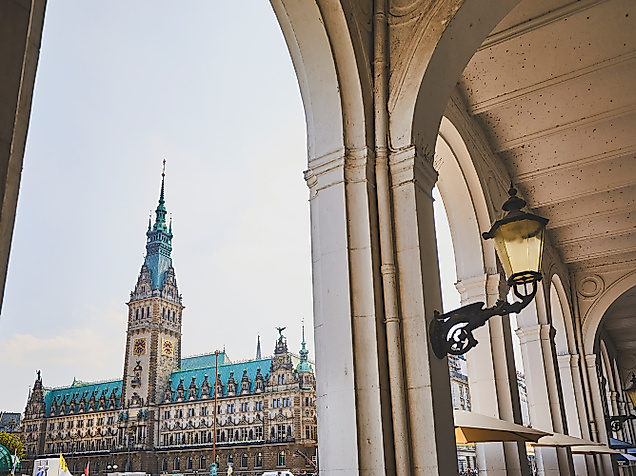
Blick durch die Alsterarkaden auf das Hamburger Rathaus mit markantem Turm
© ThisIsJulia Photography

CITY AREA PORTRAIT Alt- & Neustadt

The historic core of the Altstadt (German for Old Town) district is shaped by traditional buildings such as the Hamburg city hall and the chamber of commerce, the alleyways and bridges which stretch out all the way to the HafenCity district. In the Neustadt district district between Laeiszhalle and Jungfernstieg with elegant promenades, fashion stores and gallery owners – overlooking the Alster.

Alt- & Neustadt

THIS MIGHT INTEREST YOU AS WELL Further recommendations

St. Michaelis Kirche
© ThisIsJulia Photography

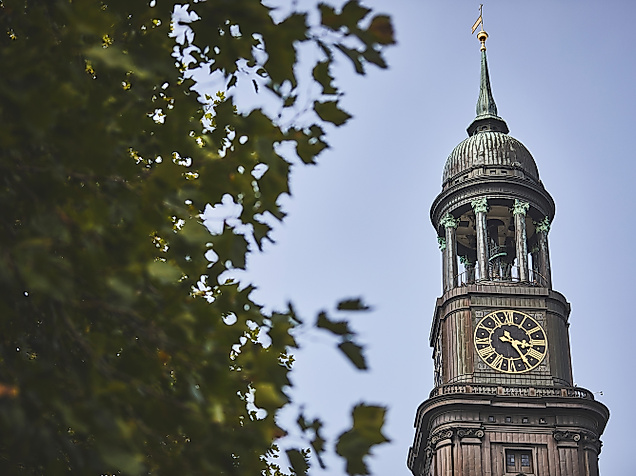
Hamburg Michel St. Michaelis Kirche

Hamburg has many large churches - but only one "Michel": On its platform 106 metres high, there is a fabulous (and breezy) view of Hamburg, the port and the surrounding countryside - one that should not be missed!

St. Michaelis Kirche
st-nikolai_c-2018-thisisjulia-photography-2
© ThisIsJulia Photography

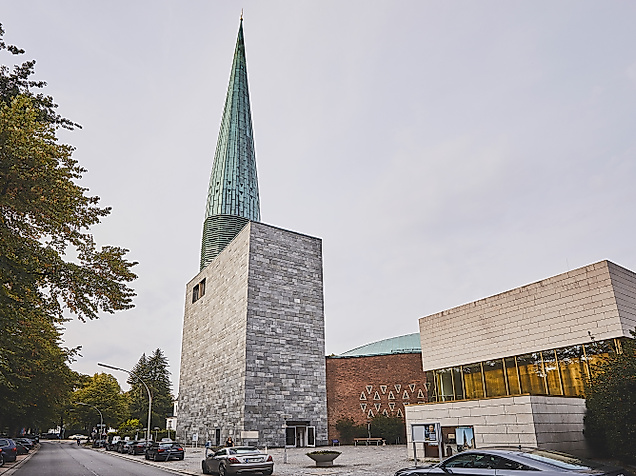
The main church at Klosterstern. Hauptkirche St. Nikolai am Klosterstern

The new building was erected from 1846 to 1874 in the neo-Gothic style to designs by the English architect Gilbert Scott and was destroyed by the bombings during the Second World War in 1943; the ruins were demolished in 1951.

Unlike the other principal churches, after the war the parish of St. Nikolai decided in 1956 against rebuilding the church on the Hopfenmarkt and instead dared a new beginning at the Klosterstern in Harvestehude, a densely populated district of the city. The new church on Klosterstern (Harvestehuder Weg 118) was built according to designs by Gerhard Langmaak and was dedicated in 1962.
Considered as both a special feature and attraction is the altar mosaic based on a design by Oskar Kokoschka, as well as the Coester window from 1939.
The former location of the main church of St. Nikolai with the 147-metre church tower – the third highest in Germany – is a ruin worth seeing on Hopfenmarkt and is considered a memorial and as a place for exhibitions and events.


Hauptkirche St. Nikolai am Klosterstern

Languages

Google translator for other languages

Please note that this is an automatic translation.
For better information, you can always switch to the German or English version