Jenisch Haus
© Sinje Hasheider
Jenisch Haus
© Sinje Hasheider
Jenisch Haus, 2024,  SHMH, Foto Jérome Gerull.01.web
© Jérome Gerull
Jenisch Haus
© Johannes Beschoner
Jenisch Haus, 2024,  SHMH, Foto Jérome Gerull.02.web
© Jérome Gerull

Jenisch House

Art and art history exhibitions

The Jenisch Haus is one of the most beautiful historic buildings in Hamburg and offers a small oasis for nature lovers with its adjoining landscape garden and breathtaking view over the Elbe.

At the gates of the city centre, the classicist country house construction of the Jenisch House, which is one of the most beautiful historic buildings in Hamburg, attracts visitors with its royal charm and the beautiful garden on the banks of the Elbe. From the southern rooms you have a great view of the river and the ships. Those who like it a little more rural should not hesitate to visit the Jenisch House.
The Jenisch House was originally the country estate of the Hamburg merchant and senator Martin Johan von Jenisch junior. It was built between 1831 and 1834 in the classicist style according to designs by Franz Gustav Forsmann and Karl Friedrich Schinkel.
Jenisch gained his popularity above all through his enormous commitment to the reconstruction of the city after the fire in Hamburg in 1842.
From the outside, the building appears very puristic, but from the inside it convinces with its princely charm. The park surrounding the building is also not to be despised. Parts of this park are a nature reserve and were only opened to the public around 1940.
Today it is a museum for art and culture on the Elbe. On the ground floor it shows representative halls with rich stucco work and parquet floors as well as furniture, paintings and sculptures from the Empire and Biedermeier periods. On the upper floors, changing exhibitions present interesting themes from art and cultural history, especially from the 19th century. The rooms on the ground floor are available for festive receptions and weddings. The museum café also has an outdoor terrace.

Hamburg CARD Benefit

Tickets

43% discount

Children up to 18 years free.

Show your valid Hamburg CARD at the cash desk and on request on the day of use. Duplication of discounts not possible.

from 12.90 €

Hamburg CARD

Free travel on buses, trains and harbour ferries (HVV) and up to 50% discount on over 150 tourist offers

Buy the Hamburg CARD now

DISCOVER NOW Events at this location

  • das-interieur-des-jenisch-hauses-foto-shmh-sinje-hasheider-2
    © SHMH, Sinje Hasheider

    Jenisch Haus Exhibitions

    • 02.11.2026
    • 11:00
    • Jenisch Haus
    To event
  • Öffentliche Führung: Parkomania
    © ©SHMH-Altonaer Museum, Michaela Hegenbarth

    Parkomania (60 Min. Öffentliche Führung) Exhibitions

    • 08.11.2026
    • 14:00
    • Jenisch Haus
    To event

More on this subject

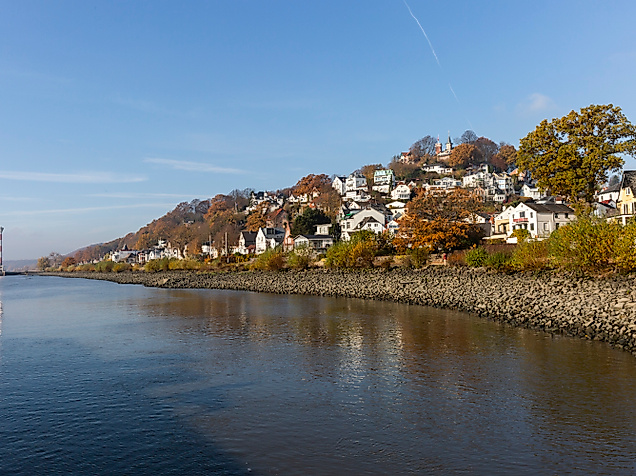
Herbstlicher Blick auf das Treppenviertel in Hamburg-Blankenese mit Elbufer und Leuchtturm
© Lee Maas / Timo Sommer

CITY AREA PORTRAIT Blankenese & Elbe outskirts

The former fishing and seamen's village of Blankenese is situated directly on the Elbe. It is the perfect starting point for hopping on a sailing boat or on the Elbe ferry, or for taking long walks along the shore. Another highlight is a visit to the Treppenviertel (German for staircase quartier) with a spectacular view of the lighthouse and the Falkenstein shore.

Blankenese & Elbe outskirts

THIS MIGHT INTEREST YOU AS WELL Further recommendations

st-nikolai_c-2018-thisisjulia-photography-2
© ThisIsJulia Photography

The main church at Klosterstern. Hauptkirche St. Nikolai am Klosterstern

The new building was erected from 1846 to 1874 in the neo-Gothic style to designs by the English architect Gilbert Scott and was destroyed by the bombings during the Second World War in 1943; the ruins were demolished in 1951.

Unlike the other principal churches, after the war the parish of St. Nikolai decided in 1956 against rebuilding the church on the Hopfenmarkt and instead dared a new beginning at the Klosterstern in Harvestehude, a densely populated district of the city. The new church on Klosterstern (Harvestehuder Weg 118) was built according to designs by Gerhard Langmaak and was dedicated in 1962.
Considered as both a special feature and attraction is the altar mosaic based on a design by Oskar Kokoschka, as well as the Coester window from 1939.
The former location of the main church of St. Nikolai with the 147-metre church tower – the third highest in Germany – is a ruin worth seeing on Hopfenmarkt and is considered a memorial and as a place for exhibitions and events.


Hauptkirche St. Nikolai am Klosterstern
Exterior view of the Bucerius Kunst Forum
© Bucerius Kunst Forum, Foto: Ulrich Perrey

Art in new contexts Bucerius Kunst Forum

The Bucerius Kunst Forum, located on the street "Alter Wall", invites its guests to enjoy an exclusive encounter with the classics of art. Four alternating exhibitions per year show, in a concentrated format, international art of the highest quality, from antiquity to classic modern art.

Bucerius Kunst Forum
st-petri_c-2018-thisisjulia-photography-1
© ThisIsJulia Photography

St. Petri

Hamburg's oldest existing church is located directly in the current shopping district on Mönckebergstrasse, and it is named after the apostle and martyr Peter, who is depicted with a key as the "gatekeeper of heaven".

St. Petri

Languages

Google translator for other languages

Please note that this is an automatic translation.
For better information, you can always switch to the German or English version