Schwanenwikbrücke

  • schwanenwikbruecke_c-2018-thisisjulia-photography-4
    © ThisIsJulia Photography

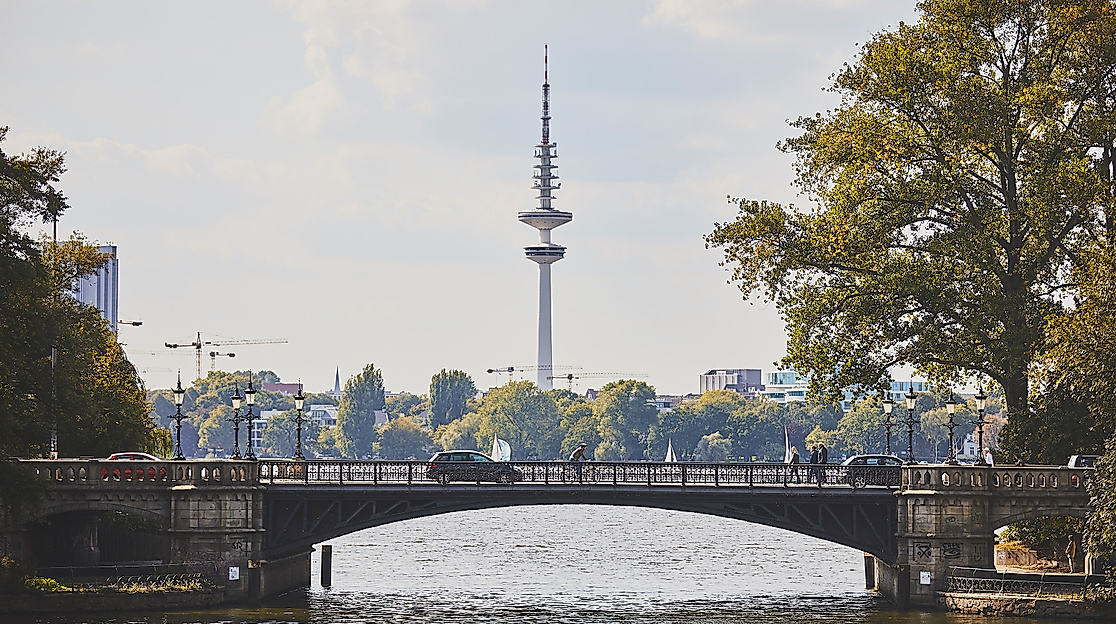
The Schwanenwik Bridge with its candelabra and wrought-iron railing is located on Hamburg's Außenalster. A special place especially for lovers...

Erected: 1874-76
Location Uhlenhorst, near Literaturhaus
Special features: Hung with countless love padlocks

If the lock is closed, the key finally seals the love, according to the ritual. The key rusts from that point on down in the water below, out of reach; the lock remains forever connected to the balustrade, inseparable. And if the key flies in a high arc from the bridge, some proclaim the oath: per sempre, forever.

It all started in Italy, at least it is supposed, and nobody knows exactly who began hanging the padlocks from bridge balustrades and where. Perhaps it really was soldiers who fixed their padlocks to the Ponte Vecchio at the end of their training. A short time later it is known that couples hung locks on the third street lamp on the north side of the 2000-year-old Ponte Milvio, until the lamppost finally collapsed under the weight of so much love.

Today, the love locks hang from bridges around the world, in Kiev and Copenhagen, Tel Aviv and Tokyo. And in Hamburg, a Facebook group was established declaring the Schwanenwikbrücke bridge to be the official love lock bridge.

The Schwanenwikbrücke bridge with its candelabra and wrought iron railings is located on the Alster lake; under the pillars spills the Wandse which flows here into the Alster as the longest tributary. During the Second World War, the two promenade passages were quickly barricaded with steel doors to make air-raid shelters, and the passages were only opened up again on the hundredth anniversary. More than a hundred locks now hang from the bridge railings, stained or rusted, engraved and inscribed with names, anniversaries, short messages; each lock is a story. On one of these was engraved: Judith and Fabian.

Judith Wahrenburg and Fabian Wienholt met on the "MS Europa"; she worked as a physiotherapist on the cruise ship, he as a butler. The voyage passed through the Caribbean, then on to South America, and on one shore leave she spoke to him. He was sitting in a bar in Havana, smoking a Cuban cigar, she wanted to photograph him; they have been together for a year now. Since November they have had a long distance relationship: He continues to travel the world on the "MS Europa", while she is back in Hamburg and time together is precious. It is certain that a shared future will be on land. And as a symbolic act, Judith Wahrenburg and Fabian Wienholt hung a lock on the Schwanenwikbrücke bridge. Just in case.
More on this subject

© Geheimtipp Hamburg

CITY AREA PORTRAIT All around the Alster

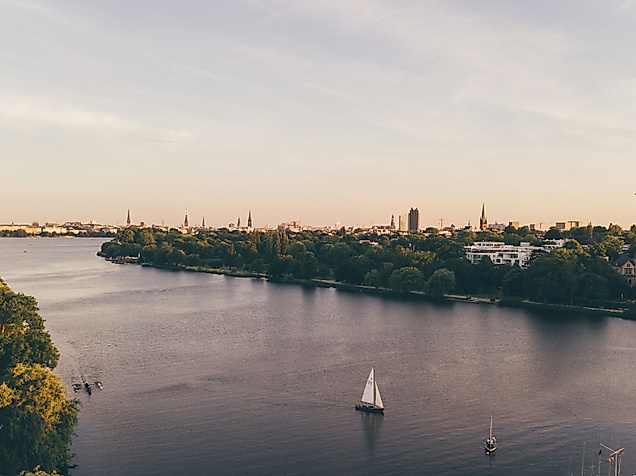
There is much to do around the Alster, one of the must-sees in our beautiful harbour city – Gründerzeit quarters and exclusive residential areas delight fans of architecture, joggers and cyclists. Many individual shops, cafés and restaurants invite visitors to linger. For a workout, for relaxation or just to take a stroll – the Alster is always a pleasant experience!

All around the Alster

THIS MIGHT INTEREST YOU AS WELL Further recommendations

st-nikolai_c-2018-thisisjulia-photography-2
© ThisIsJulia Photography

The main church at Klosterstern. Hauptkirche St. Nikolai am Klosterstern

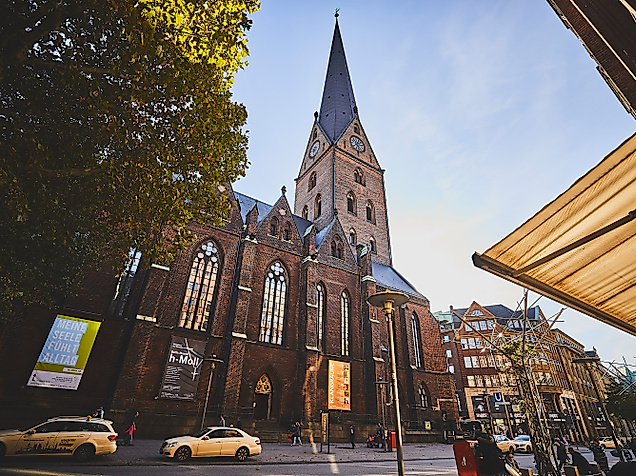
The new building was erected from 1846 to 1874 in the neo-Gothic style to designs by the English architect Gilbert Scott and was destroyed by the bombings during the Second World War in 1943; the ruins were demolished in 1951.

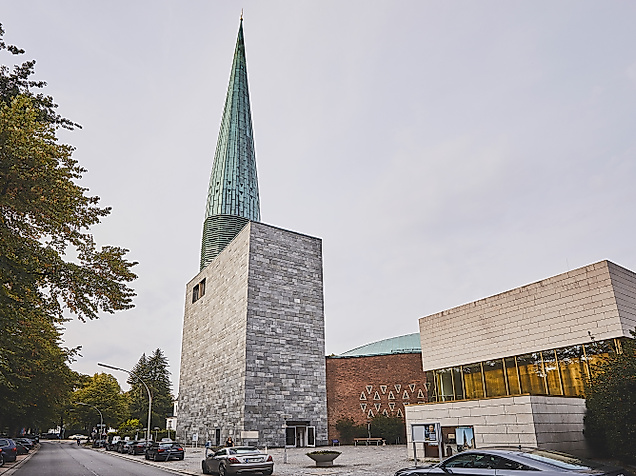
Unlike the other principal churches, after the war the parish of St. Nikolai decided in 1956 against rebuilding the church on the Hopfenmarkt and instead dared a new beginning at the Klosterstern in Harvestehude, a densely populated district of the city. The new church on Klosterstern (Harvestehuder Weg 118) was built according to designs by Gerhard Langmaak and was dedicated in 1962.
Considered as both a special feature and attraction is the altar mosaic based on a design by Oskar Kokoschka, as well as the Coester window from 1939.
The former location of the main church of St. Nikolai with the 147-metre church tower – the third highest in Germany – is a ruin worth seeing on Hopfenmarkt and is considered a memorial and as a place for exhibitions and events.


Hauptkirche St. Nikolai am Klosterstern
st-petri_c-2018-thisisjulia-photography-1
© ThisIsJulia Photography

Hauptkirche St. Petri

It was probably founded at the beginning of the 11th century, but it was first documented in 1195 as a "market church". In around 1310/20, the construction of a triple naved, Gothic basilica was begun. With the construction of a second southern nave around 1418, the essential extension works had been completed.

A second tower completed in 1516 was even higher than the cathedral, and it set the standard for all later church tower constructions in Hamburg. In 1842 the church suffered from the Great Fire; luckily, most of the works of art could be saved. The medieval structure was re-dedicated as early as 1849, but with many alterations to the church building.


Hauptkirche St. Petri
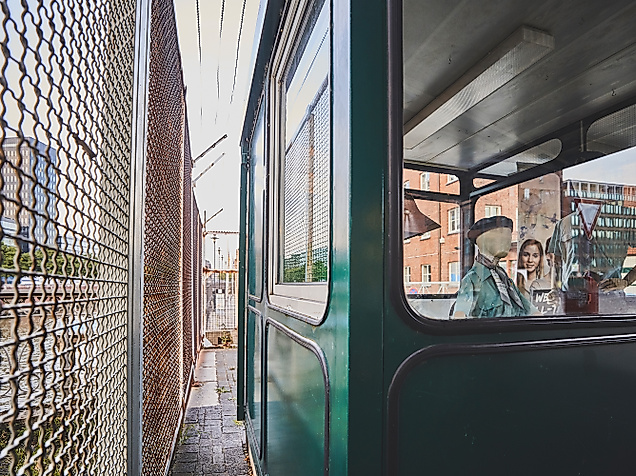
deutsches-zollmuseum_c-2018-thisisjulia-photography-1
© ThisIsJulia Photgraphy

German Customs Museum

Located in the historic Speicherstadt warehouse district, the German Customs Museum invites its guests a vivid and lively insight into the world of those who have been collecting and the German Customs Museum invites visitors to learn about the world of those who collect customs duties from ancient times to the present day and those who prefer to smuggle.

German Customs Museum

Top customer reviews

3.0 of 5 (2 reviews)

Write new rating

This is your text

Your rating *

Languages

Google translator for other languages

Please note that this is an automatic translation.
For better information, you can always switch to the German or English version